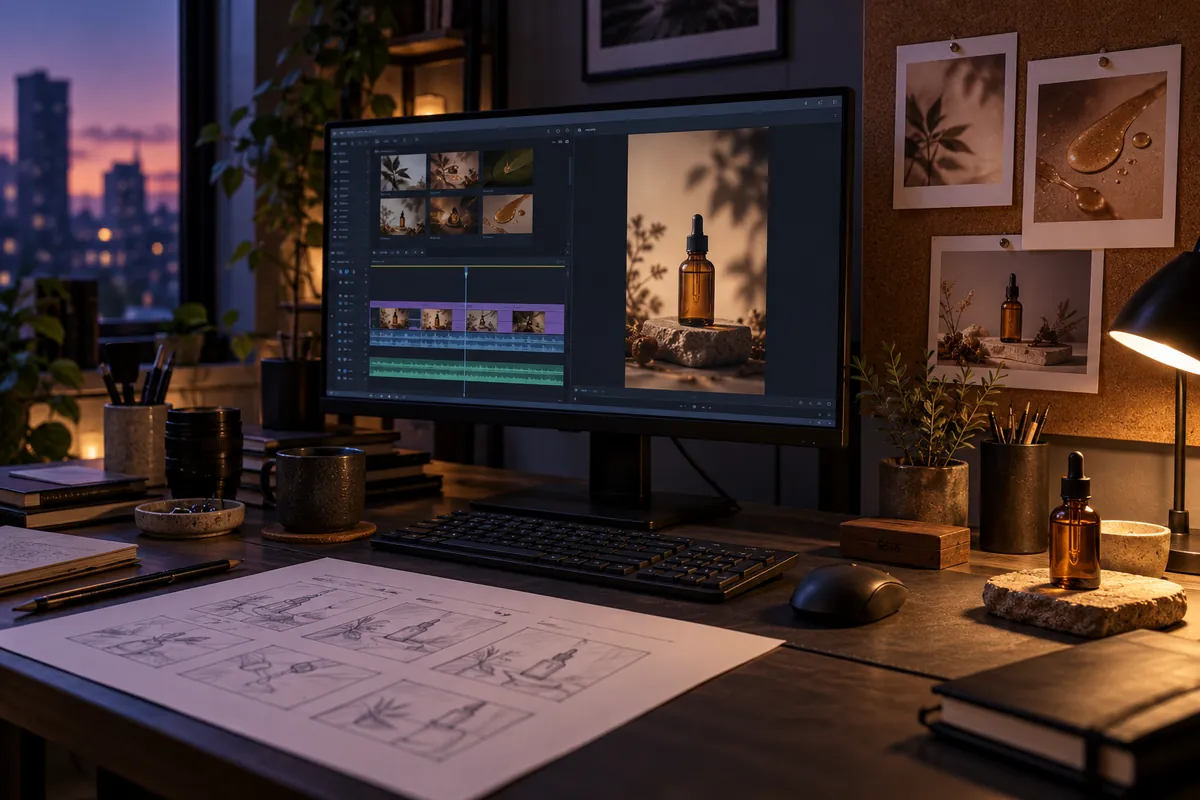
AI video has moved from experiments into real advertising budgets. Brands now commission AI-generated product ads, animated explainers and presenter videos because they can be made faster than a traditional shoot, and in more variations. Whether you end up with a usable ad depends far less on the tool than on the brief, the script and the finishing. This guide covers what to expect before you commission one.
Where AI video works well
AI earns its place when it makes something possible that would otherwise need a large set, a location or an animation budget. In commercial work that usually means:
- Product worlds. A skincare jar on wet stone at dawn, or a drink in a desert at night, without building the set or travelling to it.
- Concept and mood films. Short brand pieces where atmosphere matters more than literal accuracy.
- Presenter-led videos. A synthetic presenter, or the licensed likeness of a real person, delivering a scripted message for explainers, course promotions or service ads.
- Animation. Stylised sequences for explainers, app walkthroughs and education brands.
- Ad variations. Different openings, backgrounds or presenters for the same message, so you can test which version holds attention.
Where it still needs care
Generators are good at atmosphere and weak at precision. Plan for these limits up front rather than discovering them at the review stage.
- Labels, logos and on-screen text can warp or change between frames. Any shot where the product must be exact should use your real product photography, composited into the generated scene.
- Hands, product handling and continuity (the same face, outfit or room across several shots) take extra generation and selection time.
- Real people. Never use a recognisable face or voice without written permission, and that includes your own staff and founders.
- Claims. AI can show a result the product cannot deliver. Before-and-after visuals in beauty, health and finance ads are restricted on most ad platforms, whether the image is filmed or generated.
- Disclosure. Meta, TikTok and YouTube ask for realistic AI-generated people and scenes to be labelled in certain cases. If you advertise in the EU, check the AI Act’s transparency rules for synthetic content too.
How a commercial AI video project runs
The stages are familiar from traditional video production. What changes is where the time goes: less on shooting, more on selection and finishing.
- Brief. Offer, audience, where the ad will run, length, deadline, product assets and the claims you are allowed to make.
- Script and shot list. On paid social, the first two or three seconds decide whether anyone watches the rest, so the hook is written first. One video carries one message.
- Style frames. Stills of the look, characters and product treatment. Approving these before anything moves avoids the most expensive kind of revision.
- Generation and selection. Each shot is generated several times and the best take is kept. A 30-second ad can involve dozens of discarded takes.
- Finishing. Compositing your real product and logo, editing for pace, motion graphics, captions, sound design, licensed music and voice-over.
- Versions. 9:16 for Reels, TikTok and Shorts, 4:5 or 1:1 for feeds, 16:9 for YouTube and websites, plus shorter cut-downs of the main ad.
What to put in your brief
A complete brief removes most of the back-and-forth. Send these before you ask for a quote:
- The one action you want viewers to take, and where it happens: your website, WhatsApp, an app store or a shop.
- Who the ad is for, in one sentence, and the countries and languages it will run in.
- Platforms, formats and the lengths you need.
- High-resolution product photos or packshots, logo files, brand colours and fonts.
- Two or three reference videos you like and one you don’t, with a note on why.
- The claims you can legally make, and any your legal or compliance team has ruled out.
- Your deadline, and the date the ads need to go live.
What affects the budget
AI video is not priced by the minute. The cost moves with:
- The number of unique scenes, which matters more than total length.
- How exactly the product has to appear, and how often.
- Whether you need the same presenter or character across several shots.
- Voice-over languages, music licensing and captions.
- The number of formats, cut-downs and test variations.
- Review rounds. Agree the number in writing.
Ask for a proposal that separates the creative work from third-party costs such as music, stock or voice talent. It should also show when you will see style frames, a first cut and the final files.
Rights and ownership
Before production starts, confirm in writing who owns the final video and which files you will receive: finals only, or project files as well. Check how long licensed music can be used and in which countries, and confirm the studio has permission for any real likeness. AI tools have different terms of use, so a studio should be able to explain how the tools it uses affect commercial use.
How to judge whether it worked
Treat an AI ad like any other ad. Views and likes say little about sales. On paid social, look at:
- Hook rate: the share of impressions that watch the first three seconds.
- Hold rate: how many viewers stay past the key message or to the end.
- Click-through rate and cost per result, whether that result is a lead, a message or a purchase.
Because variations are cheap to produce, run two or three openings against each other and move budget to the one that wins. That testing loop is where AI video usually beats a single expensive shoot.
Questions to ask before you commission
- Can you show finished commercial work, not just test clips?
- Where will you use AI in this project, and where will you use real footage or product photography?
- How will you keep the product, logo and label accurate?
- How many review rounds are included, and at which stages?
- Which formats and versions does the quote include?
- Who owns the result, and which licences are included?
Dazz Media Studio produces commercial AI video and animation for brands in Sri Lanka and abroad, briefed and reviewed remotely. See the Glow by Jay AI campaign and our AI video and animation service, or send us your brief on WhatsApp.